
Technical Guidance Notes
5.6 - Forming service holes
When it is necessary to form service holes in a composite slab the following general rules are recommended. For openings at right angles to the deck span:
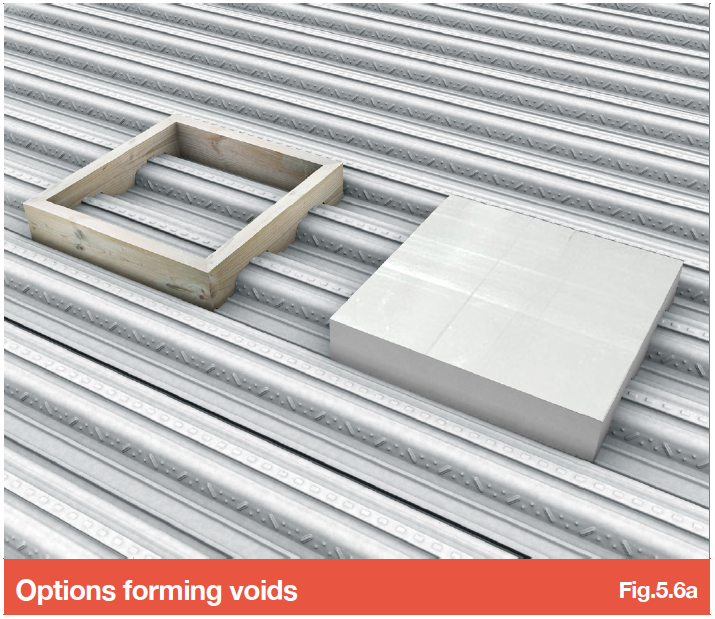
- Up to 250mm (for R51+) or 300mm (for TR50, TR60+ and TR80+ profiles): Openings such as these require no special treatment (i.e. no additional reinforcement). Prior to placing of concrete the opening is boxed out. When the slab has cured, the deck is cut by others using a non-percussive tool. (Refer Fig 5.6a).
- Greater than 250mm (for R51+) or 300mm (for TR50, TR60+ and TR80+ profiles), but less than 700mm:
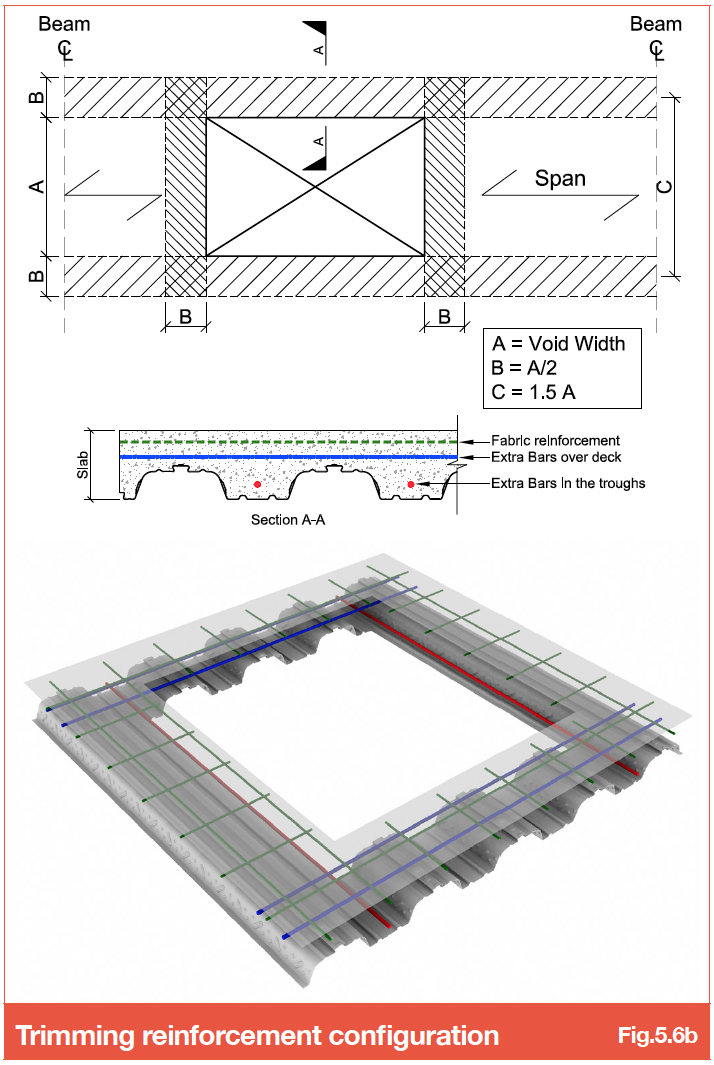
Additional reinforcement is required around the opening, generally designed in accordance with BS EN 1992-1-1 or BS8110. The forming of the hole is as item 1 (Refer Fig 5.6a and 5.6b).
- Greater than 700mm: Structural trimming steelwork designed by others and supplied by the steelwork fabricator, is recommended.
Items 1 and 2 relate to holes in isolation and not to a series of holes transverse to the direction of span, which should be considered as one large void. In these cases, the metal decking should only be cut after the slab has cured. Typically, for a void to be considered in isolation, the clear dimension between void edges in a direction transverse to the deck span should be no less than the greater of 666mm or 1.5 x void width (A in Fig 5.6b), providing no excessive concentrated loads apply to the unsupported edges.
.png)
Forming holes adjacent to beams
From the composite deck/slab design perspective there is no restriction on how close to a beam a hole in a slab is formed.
However, as indicated in SCI P300 REVISED EDITION. Composite slabs and beams using steel decking: Best practice for design and construction, ‘if the hole falls within the usual ‘effective breadth’ of concrete flange of any composite beams (typically span/8 each side of beam centre line), the beam resistance should be checked by the structural engineer assuming an appropriately reduced effective breadth of slab.’
The above guidance relates to the slab in the final condition. The deck MUST NOT be cut out prior to concreting unless the holes are fully supported on all sides and provision made to avoid concrete leaking through the hole.
These are guidelines only and particular requirements should be checked by the project structural engineer. SMD’s responsibility excludes the design of any additional framing or slab reinforcement for holes or openings.
When forming holes in the decking, consideration needs to be given to Health & Safety. Due consideration should be given to protect against falling through holes. If possible, handrails should be erected around the void. Alternatively, SMD can provide a temporary cover to the opening, by decking over the void (unconcreted), for removal by others at a later date.
Forming holes in GRP panels
For service hole forming in VoidSafe ® GRP panels, refer to Section 11.10 VoidSafe® Protection System for more information.
Keywords - void voids opening openings hole holes box out former riser
.png)





Structural Metal Decks Limited
The Outlook, Ling Road, Poole, BH12 4PY
Registered in England & Wales No. 03560591
Tel: +44 (0) 1202 718898
SMD® 2025