
Technical Guidance Notes
8.18 - Forming openings
Due to the uncertainty of size, location and number of openings at detailing stage, all openings in roof’s will be decked over by SMD and will subsequently require cutting out by others. In general, openings can be separated into three categories:
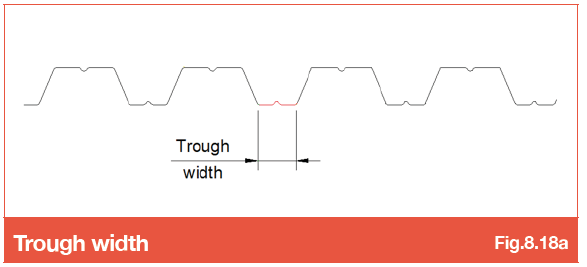
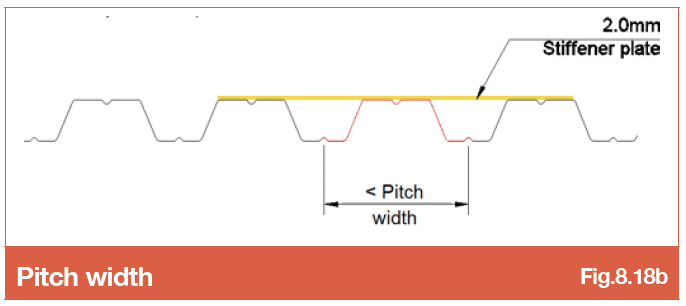
1. Small Opening (Trough width)
Local weakening in the trough is permitted without verification provided that the following conditions are achieved:
- Dmax < trough width (Where Dmax is the maximum opening size)
- Minimum centres in direction of span >20 x Dmax
- Dead weight of installed loads must be considered in the static verification
- No material is removed from the web
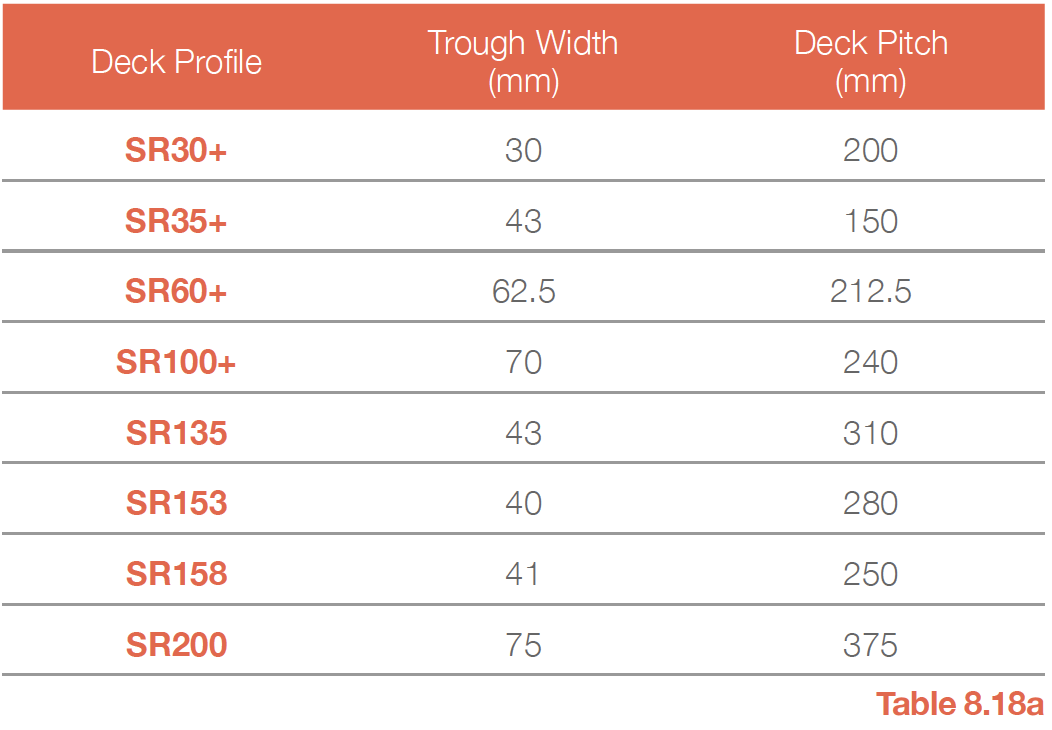
2. Medium Opening (Pitch width)
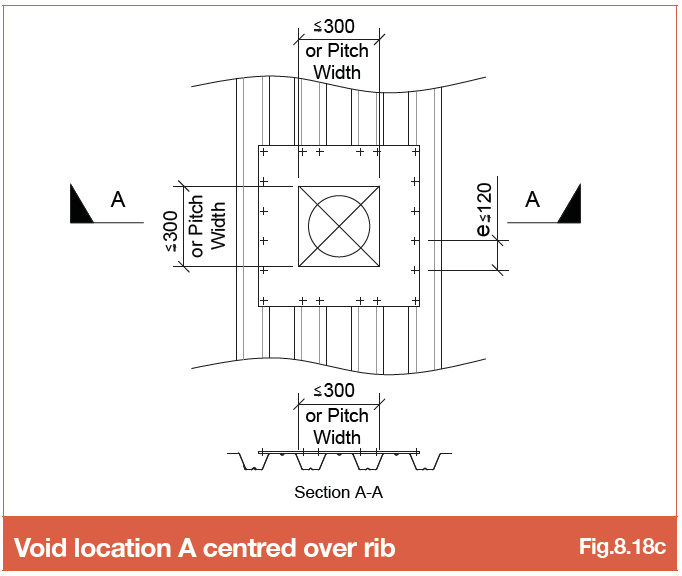
Rectangular or circular openings up to one deck pitch width or 300mm, whichever is smaller:
- Square stiffener plate required to extend a minimum of 1 pitch width in all directions from void edge.
- Minimum 2.0mm thick plate
- Steel grade and corrosion protection of the stiffener plate at least equal to roof decking
- Fixings used to be 4.8mm steel drill screws @ min. 120mm centres (see detail)
- Minimum spacing of 1000mm from edge of openings, perpendicular to the span
- Maximum of one opening in the direction of span per span.
- The stiffener plate should be installed before cutting of the roof deck sheet.
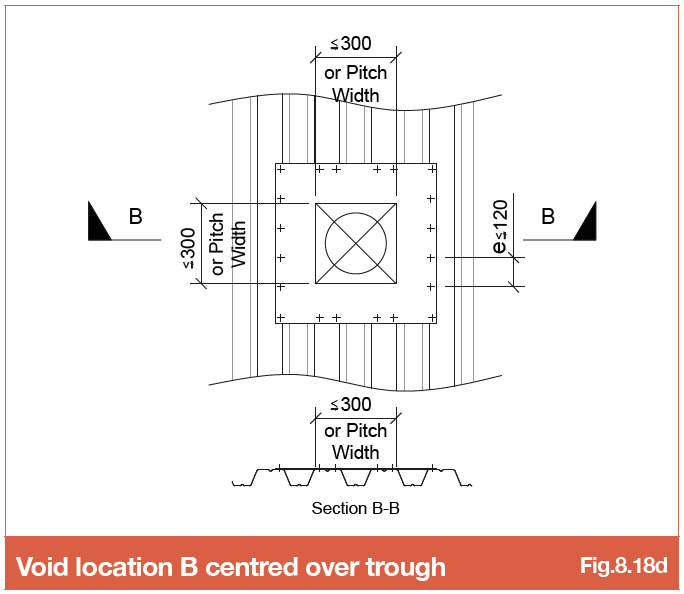
When using the above stiffener plate solution to frame a void, it is important to consider the increase in imposed load applied to the adjacent area of the structural roof deck from this stiffener framing the void. To check this an increase factor should be applied to the imposed load on the structural roof deck to account for the void removal.
Guidance on this can be found in BS EN 1090-4:2018 section B.11. The increase factor considered varies depending on the void size, span and void position as shown in Table B.5 of BS EN 1090-4:2018, the content of this table is reproduced below for information:
.png)
The SMD Technical Team are available for further guidance should you wish to check a roof deck void design.
3. Large Opening (Greater than Pitch width) For openings larger than pitch width (refer to Fig 8.18b), additional structural supports will be required.
- No restriction on opening length
- The deck profile is not designed to carry loads from within the opening
These are guidelines only and particular requirements should be checked by the Project Engineer. SMD’s responsibility excludes the design and installation of any additional structural supports, the static verification of roof decks with openings and the subsequent cutting of the deck sheet. Should point loads be required, additional trimming steel work will be required. When forming openings, consideration needs be given to Health & Safety especially the increased risk of falls from height.
Keywords void voids opening openings hole holes box out former
.png)





Structural Metal Decks Limited
The Outlook, Ling Road, Poole, BH12 4PY
Registered in England & Wales No. 03560591
Tel: +44 (0) 1202 718898
SMD® 2025