
Technical Guidance Notes
13.8 - Service fixings
13.8.1 Suspending services from floor deck
Specification
All SMD floor deck profiles offer the opportunity of utilising soffit fixings for suspending ceilings and services. Soffit fixings, also known as wedge nuts, are available to suit drop rod thread sizes of 6mm, 8mm and 10mm and can support safe working loads of up to 2.0kN (depending on the profile and drop rod size).
To avoid potential localised overloading of the slab, fixings should not be locally grouped; as a general guide, it is recommended that fixings be on a nominal minimum 600mm grid. Design advice for closer groupings should be sought from SMD Technical Team as this will depend on slab depth, profile and other design criteria for the slab.
For further guidance
Refer SMD Website Product Page along with our guidance regarding these products.
For guidance on historical deck profiles - Our blog post provided guidance when identifying key characteristics for older versions of our deck profiles.
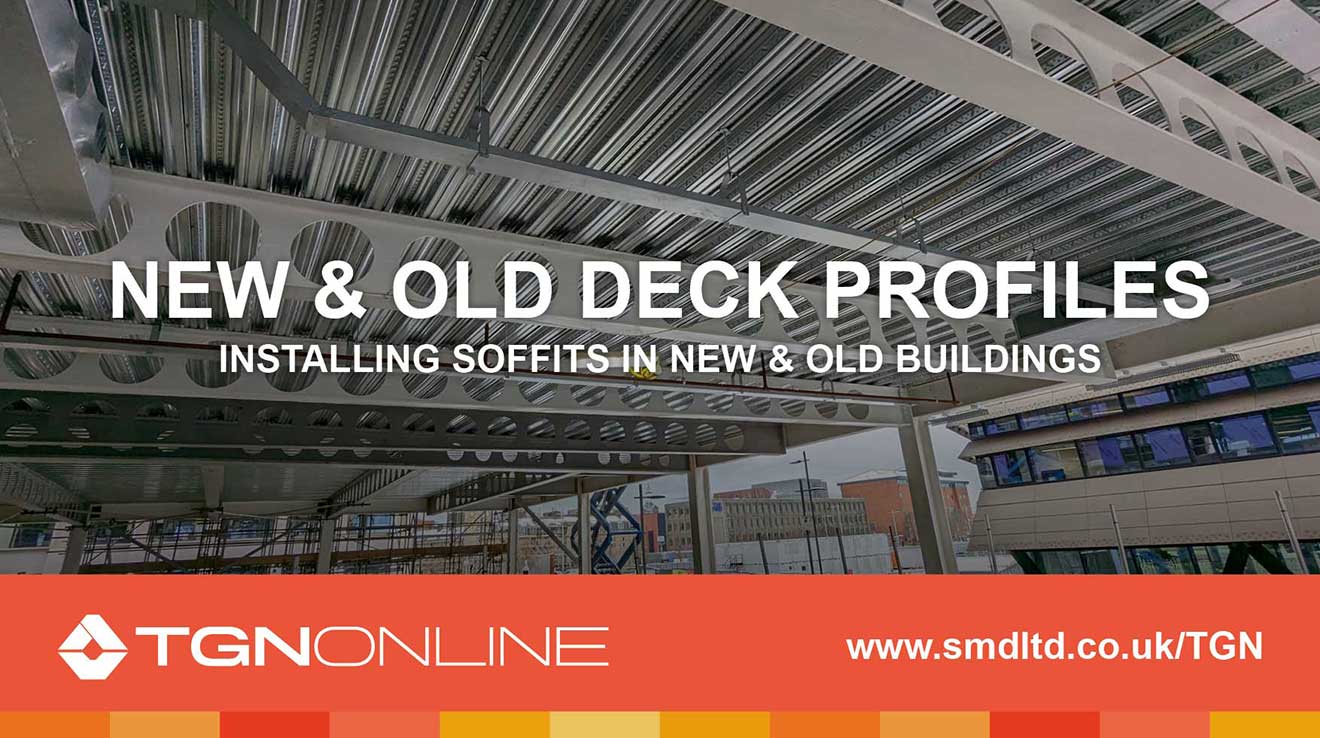
Note: Soffit fixings are only to be installed/loaded after the concrete slab has gained specified design strength.
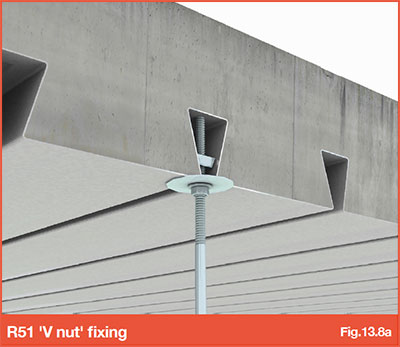
R51+ V-Nut Fixing
TR60+ and TR80+ Wedge Nut Fixing
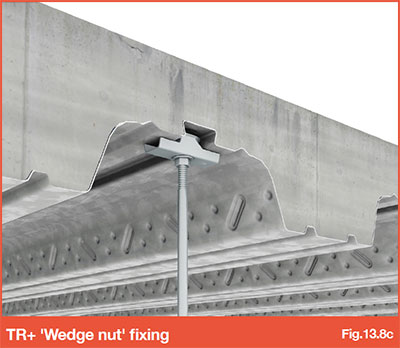
Refer Lindapter website for TR+ Service Fixing
Refer Lindapter website for R51+ Service Fixing
Installation of Service Fixing
- Ensure you have selected the correct wedge nut.
- Thread wedge onto the required rod.
- Insert wedge into the dovetail rib from below and rotate through 90 degrees so that the sloped face of the wedge bears on the decking rib.
- The rod should then be tightened by hand up to the roof of the dovetail and a washer/locking plate set against the soffit of the decking.
- Use mechanical tightening to finish to the torque force in the fixing manufacturers recommendations, refer to Fig. 13.8b and 13.8d.
Availability
Wedge nuts for all our floor deck products are available from Lindapter International Ltd. The wedge nut product names for our profiles are as follows:
- R51 Profile = ‘V’ Nut
- TR60+ and TR80+ = ‘TR60’ Nut
Other Options for Suspended Loads
Other fixings and proprietary anchors are also available. These should be used in accordance with fixing manufacturers guidance. The approval of such fixings should be sought from the project structural engineer. Where the load to be suspended exceeds the wedge fixing recommendation, ensure the load does not exceed the slab design capacity before considering any alternative options.
Where bolting through the slab is proposed:
- Ensure the use of non-percussive methods to minimise disturbance of the bond between deck and concrete.
- Position any bolt position through the trough section of the slab with an appropriate spreader plate size to suit the load applied.
- The exact load and position should be checked using SMD Elements® design software.
13.8.2 Suspending load from SR Roof deck
There are two primary methods for suspending lightweight ceiling and services loads from the underside of structural roof deck. These are:
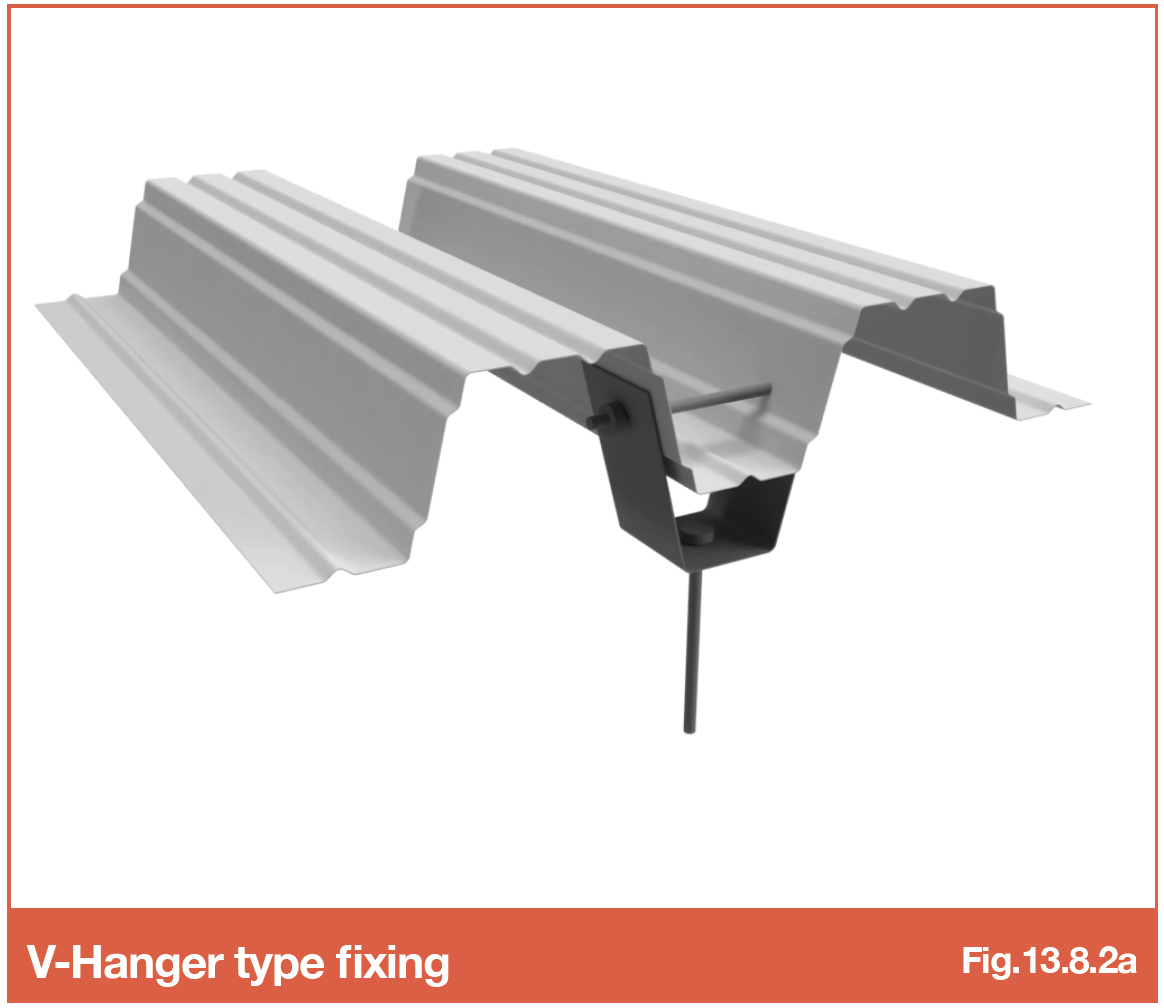
- Using a proprietary fixing that involves drilling through or fixing into the profile to provide the required resistance. Refer Fig.13.8.2a for available proprietary fixings and suppliers
- Fixing a Unistrut channel to the underside of the profile using stitching screws in every trough. The load can then be hung from the Unistrut channel. Refer Fig.13.8.2b for typical layout for Unistrut channel
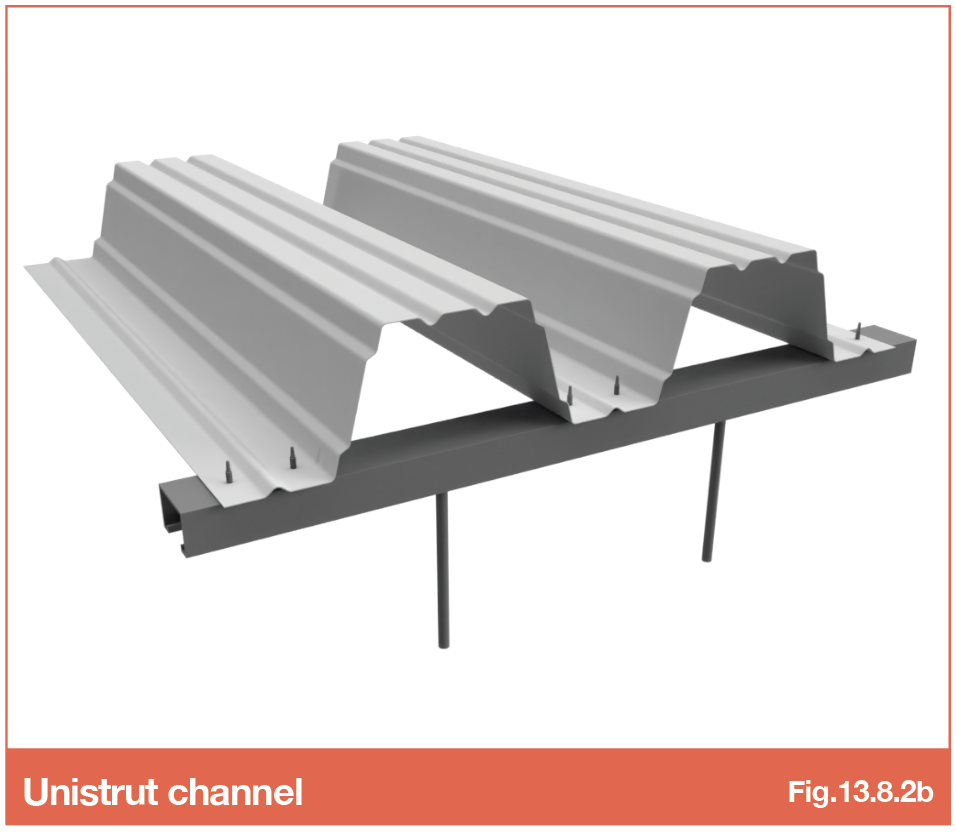
For both of the above soffit fixing methods, the load being suspended must not exceed the lesser of i) the maximum UDL allowable for the profile when considered with all other loads being applied to the sheeting and ii) the pull-out resistance of the proprietary fixing or stitching screws (when using a Unistrut system).
To avoid local overloading, it is recommended that hangers are spaced at centers no closer than alternate ribs of the profile, providing the load to be suspended is within the acceptable UDL for the profile and span.
For more information on proprietary fixings for hangers, See nVent regarding their Caddy range and www.unistrut.co.uk
For any queries relating to a specific soffit type fixing, or load, contact the SMD Technical Team.
.png)





Structural Metal Decks Limited
The Outlook, Ling Road, Poole, BH12 4PY
Registered in England & Wales No. 03560591
Tel: +44 (0) 1202 718898
SMD® 2025